OVERVIEW
- During the reporting period, Safeguard Bulawayo recorded 21 criminal incidents, comprising 12
break-ins, 7 thefts and 2 robberies. While overall figures remain moderate, residential and industrial
sectors continue to demonstrate vulnerability, particularly in the Eastern suburbs and established
industrial zones in the West.
- Residential properties were the most affected, accounting for eight of the recorded incidents followed
closely by industrial or manufacturing sites in the Western parts of the city.
- Suburbs, Ilanda, Selborne Park, Khumalo and Morningside featured prominently.
- Industrial and manufacturing sites in Steeldale, Thorngrove, Belmont and Donnington were also targeted, particularly for armoured cabling, batteries and other portable valuables.
- Activity was also reported in the city’s central business district.
- The reporting period was further characterised by:
- Fire and gas-related incidents in Lobengula West and the CBD.
- Human-wildlife conflict fatalities in Matabeleland North.
- Public health alerts including waterborne disease risk, rabies vaccination campaigns and bilharzia treatment programmes.
- Approval of the 2026 Presidential Amnesty.
- Announcement of the introduction of new ZiG bank notes effective April 2026.
Overall, risk remains dynamic and continues to evolve and increase because of various social, economic and political issues internationally and locally.
OUTLOOK
Risk over the next 30-90 days is likely to be shaped by economic transition, and global uncertainty. The introduction of new ZiG denominations in April 2026 may drive increased cash withdrawals and private cash storage thereby elevating exposure to robbery, insider theft and targeting of cash-heavy businesses. The Presidential Amnesty is likely to also increase short-term opportunistic and petty crime as reintegration pressures intersect with limited economic absorption capacity. Geopolitical instability in Iran and Gulf trade
corridors, including Dubai, could disrupt commodity pricing and fuel stability, potentially driving parallel market volatility and related crime. While large-scale organised violence remains unlikely, economically motivated offences, property crime and cash-related targeting are assessed as highly probable.
ADVISORY
Residential
- Adopt a few layers of security for best effect. A basic alarm and response are essential, and build out from here with good lighting, good perimeter deterrent, and make doors and barriers as strong as possible to slow and deter entry.
- Smart home devices, CCTVs, and access systems should be protected by passwords to prevent criminals from exploiting digital vulnerabilities to bypass physical security.
- Avoid predictable routines that could be exploited by criminals (leaving the same windows open or
posting real-time location updates on social media).
- Regularly review the security posture of your property and address vulnerabilities without delay.
Industrial and Manufacturing
- Integrate CCTV and alarm systems with professional monitoring to ensure rapid response to incidents, even when the site is unoccupied.
- It is essential that cameras are connected to response so that we can see what is going on at the site
and can respond effectively.
- Restrict access to authorized personnel only through ID verification, turnstiles, and time-sensitive access credentials.
- Do not publicly share sensitive information that could expose the site to risk.
- Engage with other companies in your industry to share intelligence on potential threats.
General Advisory
- In the event of an armed robbery, do not resist and always assume that the firearm is real and loaded.
- Conduct thorough background checks and vetting of all employees, contractors, and service providers
to reduce the risk of insider threats.
- Use strong, unique passwords for your financial accounts and enable two-factor authentication wherever possible to add an extra layer of security.
- Regularly consult with Safeguard to receive professional advice, threat intelligence updates, and
recommendations tailored to your specific operational context.
Key Risk Trends and Patterns based on both internal and external incidents
- Money and easily resalable goods remain the primary targets across residential, commercial, and
industrial premises.
- Several losses were attributable to inadequate security measures and valuables being left in
unsecured areas.
- High risk periods were between 0300hrs and 0400hrs for break ins and day light hours for thefts.
- The modus operandi observed at residential sites involved offenders cutting the razor wire before
scaling the precast wall to gain entry.
- Vehicles with fake registration plates continue to be seen loitering outside sites.
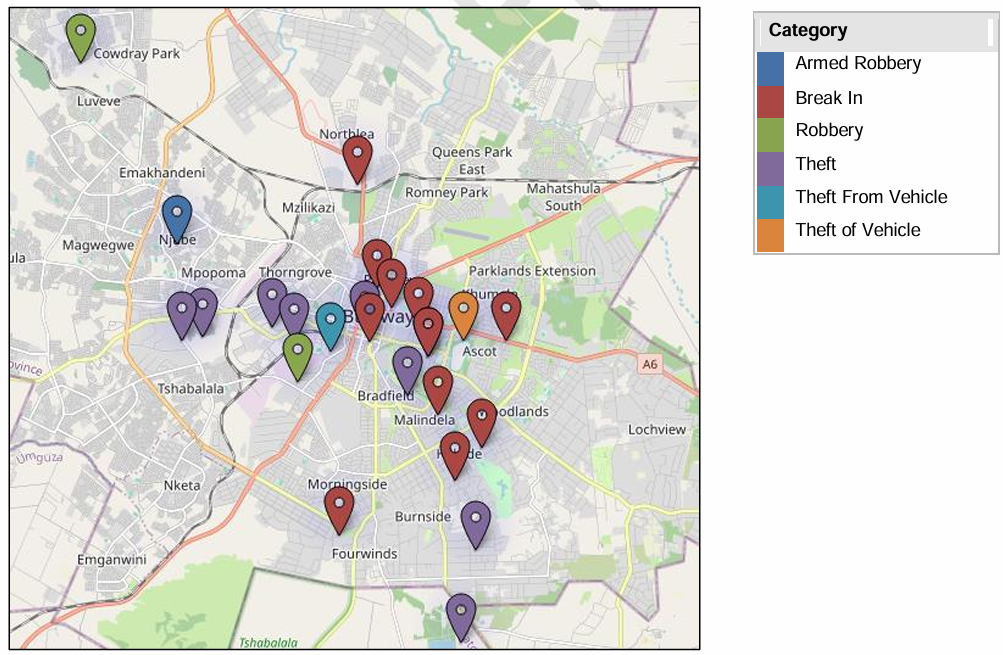
GENERAL MAP OVERVIEW OF CONFIRMED INCIDENTS IN BULAWAYO
Thank you for using Safeguard
The Safeguard Team
If you want to know more about crime in your area, or would like security solutions advice, please drop us a line at
byoanalyst@safeguard.co.zw. You can also call Safeguard Bulawayo on
+263 292 885509-17 extension
3211 for assistance or speak to your local Safeguard manager for advice on site. Please see more information relating to crime statistics below.
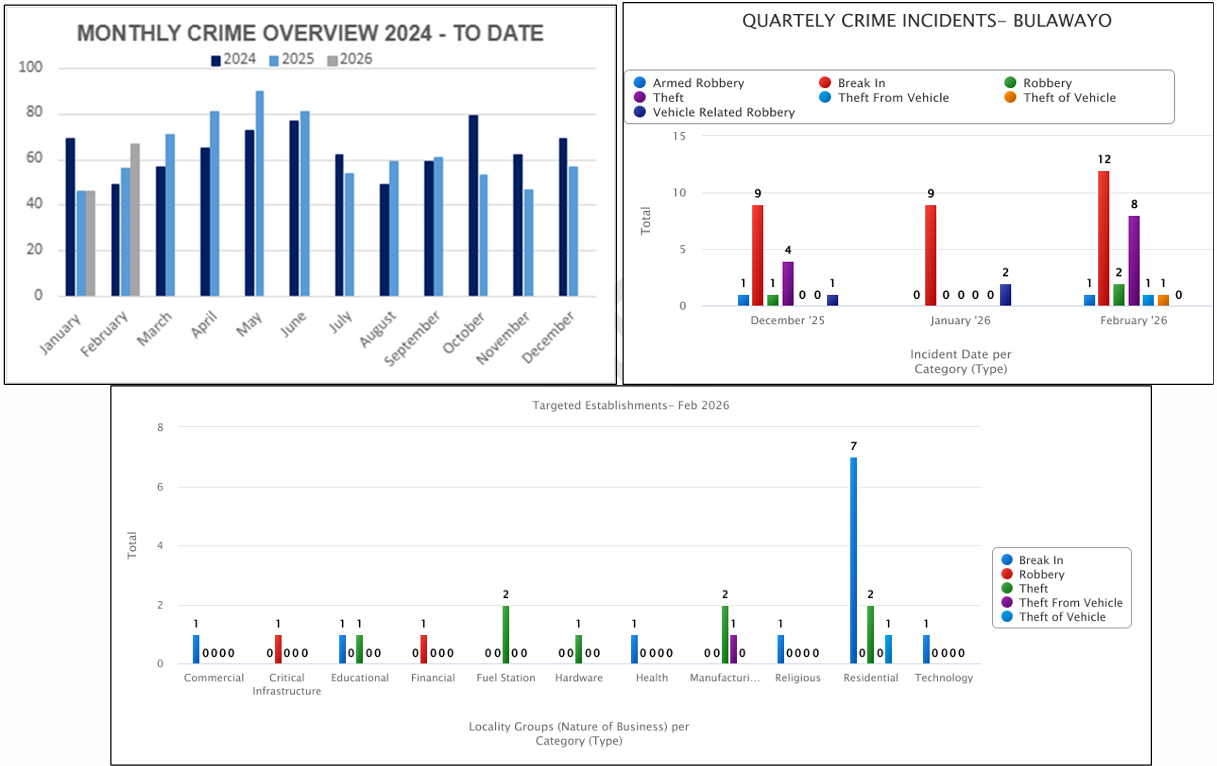
CRIME INCIDENT ANALYSIS
The above graph shows incidents captured by the security service provider in the past three months.
TRAVEL, HEALTH AND SAFETY ALERTS
- Road travel risks remain elevated across Bulawayo and Matabeleland regions due to fatal collisions,
deteriorating road infrastructure and weather-related hazards.
- Along the Old Esigodini Road near the Rio turn-off, a collision involving two vehicles resulted
in injuries when one of the vehicles caught fire after sideswiping the other.
- Major highways remain high risk with fatal crashes reported on the Beitbridge-Harare Highway
and Bulawayo-Victoria Falls Road.
- Infrastructure deterioration continues to increase travel hazards:
- The Bulawayo–Maphisa (A6) Road is reported to have extensive potholes increasing the likelihood of punctures and loss of vehicle control.
- Sections of Old Gwanda Road, and routes within Umzingwane and Insiza districts have also been affected while low lying bridges along rural Matebeleland South remain high risk during heavy rainfall.
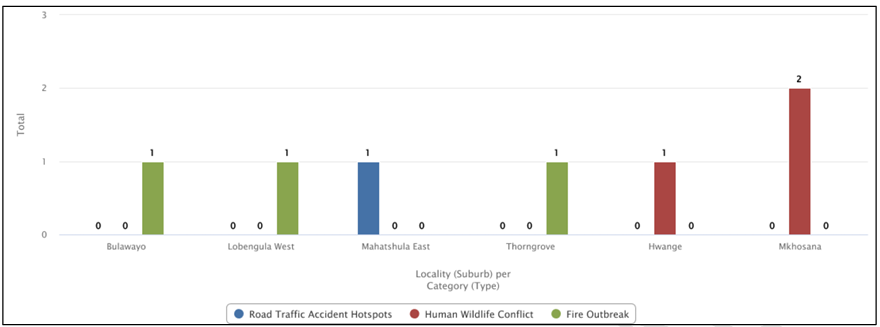
- Human-wildlife conflict remains a concern in Matabeleland North. Two fatal elephant attacks were
reported in Victoria Falls (Mkhosana), while a child was killed by a crocodile near the Matetsi River
along the Bulawayo-Victoria Falls Highway.
- Additional safety incidents included a fatal gas-related fire in Lobengula West and an electrical fire at a commercial property in Bulawayo CBD.
- Persistent rainfall and pressure on water and sanitation systems continue to elevate the risk of
waterborne diseases such as cholera, while rabies remains a concern in areas with stray or unvaccinated animals requiring continued vigilance.
Proactive Measures
- Restrict non-essential night travel along high-risk highways and poorly maintained regional routes.
- Conduct pre-travel vehicle inspections and always carry all the necessary breakdown tools.
- Implement wildlife awareness briefings and restrict access to riverbanks or areas with known elephant activity, especially during dawn and dusk.
- Fire detection systems and electrical infrastructure should be inspected and tested regularly, and
evacuation procedures rehearsed for all staff.
- Practice strict water safety and hygiene and ensure immediate medical attention for animal bites or suspected exposure to infectious diseases.
Get the latest Crime Report in your inbox: simply complete the form below: